Security decides more storage rentals than price does, and almost nobody says so on the quote call. A plant manager will accept a longer lead time, a fussier delivery window, and a spot they did not really want, as long as they believe the box will still be full on Monday morning. So before you compare cost or availability, it is worth asking the question straight: is a ground level storage container actually harder to hit than a storage trailer?
The honest answer is that neither one is stronger. They are vulnerable in opposite places. A container is hard to move and easy to walk up to. A trailer is easy to move and awkward to get into. Which of those matters on your site depends on your fence line, your lighting, and what is going in the box. We have been placing storage trailers around the Cincinnati Tri-State since 1990, and this is the comparison we walk people through when security is the deciding factor, including the part where the container wins.
- The two units fail in opposite directions. A container is hard to steal whole and easy to approach. A trailer is easy to steal whole and hard to approach.
- Container doors sit at ground level, so anyone who gets past the lock works standing up with both hands free. A trailer floor sits 48 to 52 inches off the ground, which turns a grab and go into a climb.
- Whole unit theft is where the container genuinely wins. Lifting one takes a tilt bed or a crane and several conspicuous minutes. Hooking an unsecured trailer takes a tractor and about a minute.
- A kingpin lock and a glad hand lock close most of that gap, and together they cost less than one pallet of what you are storing.
- Placement outranks both. Doors to a wall, inside the fence, under a light, in view of an occupied building beats any lock on either unit.
What is the real security difference between a storage container and a storage trailer?
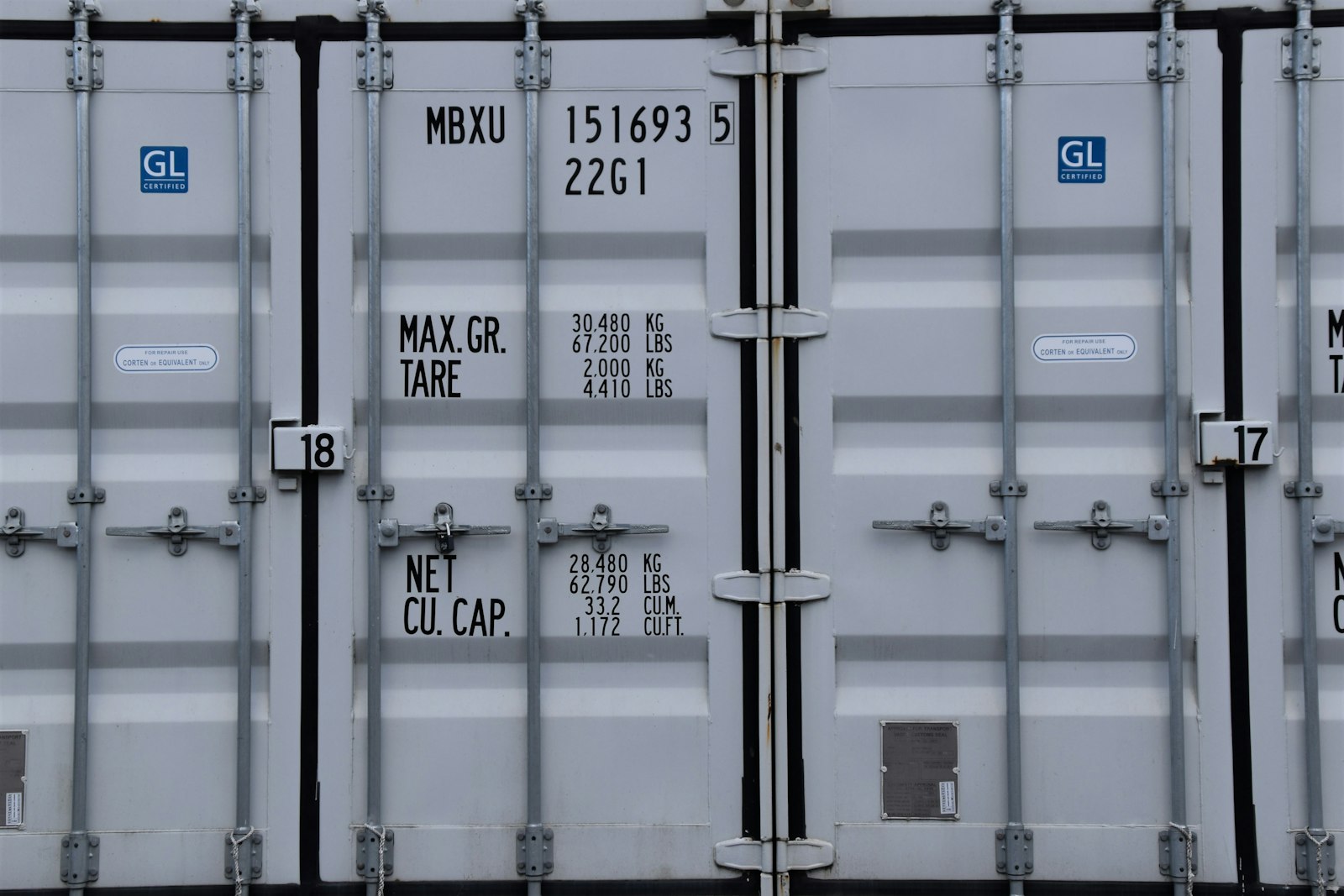
Start with how the two are actually built, because the hardware explains everything that follows. A shipping container is corrugated steel welded to a rigid frame with cast corner blocks. Its doors carry four vertical locking bars, each held top and bottom by cam keepers, and most units have a welded lockbox: a steel shroud that covers the padlock so a bolt cutter cannot reach the shackle. It is genuinely good door hardware, and it comes standard.
A storage trailer is a different animal. Aluminum or composite sidewalls over a steel frame, riding on a chassis with a kingpin at the nose and landing gear underneath. The swing doors use the same locking bar and cam idea, closed with a hasp that takes your own padlock. So the trailer has one security story the container does not: the coupling. That kingpin is a standardized connection point, which is exactly what makes a trailer easy to deliver, easy to reposition, and easy to take.
Everything below is downstream of those two facts. The container's story is entirely at the doors. The trailer's story is at the doors plus the front end.
Which one is harder to break into at the doors?
A standard padlock shackle is the weak point on any door in any industry, and it is the weak point that thieves plan around. The container's lockbox solves it by hiding the shackle inside steel. On a trailer you solve the same problem by buying the right lock: a shrouded puck lock is round, sits flush in the hasp, and presents nothing to cut. It costs a small fraction of a month's rent, and it is the single highest return purchase in this entire comparison.
Once both units are wearing a shroud, the door contest gets boring, which is the correct outcome. Both use vertical locking bars with cam keepers. Both hinge outward on pins that are welded on any unit worth renting. Both will hold against a person with hand tools and a short window, and neither will hold against a person with a grinder and twenty unobserved minutes. If a grinder in your yard for twenty minutes is a realistic scenario, no lock on this page is your answer. Lighting and sightlines are.
We cover the lock selection itself, plus cargo seals and the day to day checks, in our post on storage trailer security basics. This post is about the choice between the two units, not the hardware list.
Which one is harder to steal outright?
This is the part of the comparison a trailer company has every incentive to skip, so here it is plainly. Any tractor with a fifth wheel can couple to an unsecured trailer. The air lines are quick connects. The landing gear cranks up in under a minute. Nothing about the process looks unusual to a passerby, because it is the same motion that happens ten thousand times a day at every dock in the country. A thief stealing a container looks like a crime. A thief stealing a trailer looks like a driver doing their job.
Three things close that gap, and all three are ordinary practice on a well run yard. A kingpin lock is a steel collar that covers the kingpin so no fifth wheel can lock onto it. A glad hand lock caps the air connections so the brakes cannot be released. And nose in placement, backing the trailer's front end against a building or a barrier, means a tractor has nowhere to line up in the first place. Do those three and the trailer's whole unit exposure drops below the container's, because the thief now needs tools, time, and noise inside your fence, and that is precisely what they are trying to avoid.
There is a flip side to the container's advantage that rarely gets mentioned. Whatever makes it hard for a thief to move makes it hard for you to move. If your yard layout changes, if a building goes up, if the lighting you were counting on gets rerouted, moving a container is a crane call and a scheduling exercise. Moving a trailer is a phone call to us and one truck.
Does the floor height change who can get into your load?
Dock height normally gets sold as a loading advantage, and it is one. It is also a security feature nobody puts on a spec sheet. A ground level container is, from a thief's point of view, a walk in closet. Get the door open and the work is done at waist height with a dolly. A trailer standing on its landing gear presents a four foot wall, and freight has to come over it one armful at a time.
Spot that same trailer at a dock and the height stops being a wall and becomes a second locked barrier, because now the load has to come out through your building. That is the arrangement we recommend whenever a dock position is available, and it is the same reason warehouses choose 53 footers in the first place. We walk through the operational side of that in our post on dock height loading.
Be fair about the trade, though. Height that slows a thief also slows your own crew. If the unit will be loaded by hand, in a yard, with no dock and no ramp, the container's ground level floor is a real daily advantage and you should weigh it honestly against a security benefit you may never need to cash in.
How much does yard placement change the answer?
The single most effective thing you can do costs nothing: park the doors where they cannot open. Doors facing a wall, a fence, or the side of the building means the unit has to be moved before it can be entered, and moving it is the loud part. Nearly every storage theft we have heard about over the years involved a unit sitting with its doors facing open ground, usually at the far end of a lot, usually because that was the easiest place for the driver to drop it.
After that it is the ordinary list, and it applies identically to both units. Inside the fence line. Inside the reach of lighting you already run at night. Within sightline of an occupied area or of a camera you already own, rather than a camera you plan to buy. Away from the fence itself, so nobody can work on it from the far side.
Here the trailer has a quiet structural advantage. Your yard is not static. Trucks change routes, buildings get added, that light gets moved, a lease line shifts. A trailer follows those changes for the price of a phone call. A container mostly stays wherever the first crane put it, which means a placement decision made in a hurry on delivery day becomes a permanent one.
So which one should you rent if security is the deciding factor?
Put concretely, the container is the better call when the site itself cannot be secured. A remote yard, a lot with no fence, a location nobody is at overnight. In that situation the deterrent has to be the box, because nothing else is doing the work, and a container is the better box for that job.
The trailer is the better call in every scenario where your site is already doing part of the work, which covers most manufacturing plants, warehouses, and distribution sites in the Tri-State. Inside a fence, near a building, in view, with a puck lock and a kingpin lock fitted, the practical difference in risk is small, and you get back the two things the container costs you: a floor at dock height and a unit that can be repositioned whenever your operation changes. If you are weighing the two on more than security alone, our full storage trailer versus storage container comparison covers cost, loading, and delivery, and our storage trailer rentals page lays out what the swap looks like in practice.
Our storage trailer rentals run 28, 45, 48, and 53 feet, every rental carries a 3-month minimum and then runs month-to-month until you release the trailer, and delivery is on our own trucks and drivers. Check your town on the areas we serve page, then request a quote or call (513) 772-9490. Tell us what is going in the box and where you plan to put it, and we will tell you honestly whether a trailer is the right answer for that spot.
Frequently asked questions
Does a storage trailer come with a lock?
No, and that is deliberate. You supply the lock and hold the only keys, which means nobody at our yard can open your trailer. Buy a shrouded puck lock rather than a standard padlock: it sits flush in the hasp and leaves no shackle for bolt cutters to reach.
Can a thief really hook up a storage trailer and drive away?
Yes, if nothing stops them. Any tractor with a fifth wheel can back under an unsecured trailer in about a minute, and it looks completely routine while it happens. A kingpin lock blocks the fifth wheel from coupling, a glad hand lock keeps the brakes locked, and parking nose in against a building means a tractor cannot line up at all.
Is a shipping container harder to break into than a storage trailer?
At the doors, marginally, because of the welded lockbox that shields the padlock. Fit a shrouded puck lock to the trailer and that difference is small. The larger and more useful differences are the container's ground level access, which helps a thief, and the trailer's coupling, which needs a kingpin lock.
Does insurance treat containers and trailers differently?
Policies vary enough that you should ask your carrier rather than take our word for it. What underwriters generally ask about is the same for both units: whether it sits inside a fence, whether the area is lit, what locking hardware is fitted, and whether the contents themselves are covered. Have those four answers ready before you call.
Can I move the trailer to a different spot later?
Yes. Call us and we reposition it with our own equipment. That flexibility is a real security advantage over a container: as your yard layout, lighting, or traffic pattern changes, the trailer can follow. Moving a container means arranging a crane or a tilt bed and paying for the visit.