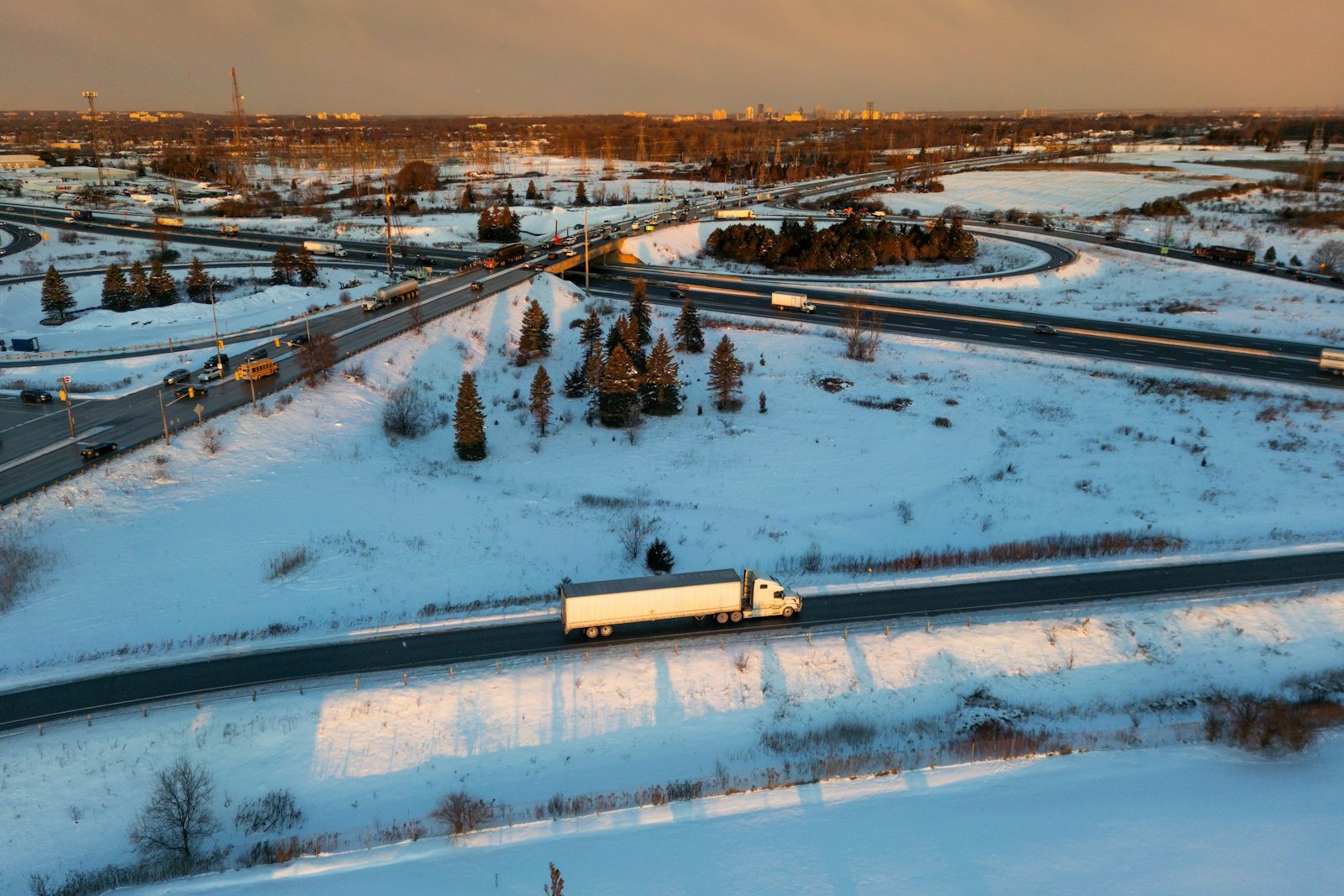
Snow stops fewer local runs than almost anyone expects. In the Tri-State the thing that actually kills a same day delivery in January is hardly ever the road. It is a dock with nobody standing at it.
Everything written about trucking in winter is written for the driver. Chains, tire pressure, following distance, what to keep in the cab. None of it answers the question a shipping manager is asking at 6:40 in the morning with an inch of snow on the cars and a load that has to be across town by two. We have been hauling freight out of West Chester since 1990, which is a lot of winters in this valley, and the pattern is consistent enough to plan around.
- Plowed roads are rarely the problem. Most Tri-State snow is cleared off the main routes before first shift is over, and local freight keeps running.
- The failure is almost always at a building, not on the road. A receiving department sent home, an unplowed dock apron, a leveler pit full of slush, nobody with authority to sign.
- Winter compresses the day. Call by noon Monday to Friday and same day is still the standard inside our hundred mile radius, but the morning half of a winter day is worth far more than the afternoon half.
- Holiday weeks are harder than snow weeks and nobody plans for them. Receiving hours shrink days before shipping hours do, and the week between Christmas and New Year is the worst offender.
- If the real problem is that your floor is full and the dock is backed up, another truck run does not fix it. Space does.
Does freight still move when it snows in Cincinnati?
It is worth separating the two, because people use one word for both and then make the wrong plan. Snow is a slow down. The lanes get cleared, the shoulders stay white for a week, and a run that normally takes forty minutes takes an hour. Ice is a stop. When the surface glazes over, nothing moves safely, hills and bridges go first, and the honest answer from any carrier is that the load waits.
What makes our region its own case is the terrain. Greater Cincinnati is cut up by hills and river valleys in a way that flat Midwest freight markets are not. The interstates get treated first and recover fast. The grades getting up out of the valley, the ramps, and the two lane county roads out toward the edge of the radius recover hours later. So a run from West Chester to Fairfield can be completely ordinary on a morning when a run down into Northern Kentucky or out into southeast Indiana is genuinely slow. One weather report, three different answers, depending on the lane.
That is why a local carrier can usually give you a straight answer. We run the same forty or fifty miles of road every day in both directions. The question is not what the forecast says. It is what the specific lane your load is on looks like right now.
What actually stops a local load in winter?
This is the single most useful thing we can tell anyone planning winter freight, because it is the opposite of what people brace for. They spend the morning watching the radar and the roads, and the load dies at the consignee.
The ways it happens are boringly repetitive. A plant calls a two hour delay and the office staff work from home, so the phones get answered and the dock does not. A distribution center runs a short crew and closes receiving at one o'clock instead of four, and nobody told the shipper. The apron in front of the dock doors is the last thing on the property to get plowed, because it is not where the cars park, so a tractor cannot back square to the building. The dock leveler pit is packed with frozen slush and will not drop. The lift truck has been sitting outside on propane in twenty degree weather and will not start. Somebody with signing authority is out and the person on the dock will not touch the paperwork.
None of that is a trucking problem and all of it ends the same way, with freight sitting on a truck and a phone call that could have happened the day before.
There is a second pattern worth naming. In winter the shipping end tends to be ready and the receiving end tends not to be, because the people loading freight are at work by definition and the people receiving it may not be. If you only confirm one end of a winter run, confirm the far end.
What changes during a holiday week?
From late November to the first week of January, the thing that breaks schedules in this market is not weather at all. It is staffing. A plant that normally takes freight until four is taking it until noon on the Wednesday before a holiday. A warehouse that is open all week has three people in it on the Friday after. Offices stay open and docks do not, which is exactly the trap, because the person you confirmed the delivery with answered the phone from a desk and had no idea the dock crew went home at eleven.
The fix is unglamorous and it works. For any delivery falling in a holiday week, confirm the receiving window with the receiving department rather than with purchasing, and get a name and a direct number on the dock. Ask the specific question, which is not "are you open" but "who is on the dock Thursday and until what time." Then book earlier in the day than you normally would, because a short dock day has no second chance in it.
Peak season makes this worse for anyone moving retail or seasonal product, since the same weeks that compress the dock calendar are the weeks the floor is fullest. We wrote about how that pile up works in Q4 inventory overflow, and the short version is that the congestion is usually a space problem wearing a scheduling costume.
How does the noon cutoff work on a bad weather day?
A winter day has fewer usable hours in it than a June day, and it is not only daylight. The first run of the morning is slower while the plows are still working, the afternoon has less light at the dock, and a receiving department that closes at four in July may be closing at three in December. Fewer hours of productive dock time, on a day the driving is slower, is the real constraint. The cutoff is the same. The room behind it is not.
So the practical adjustment for December and January is to move your booking habits forward. A load called in at 9:00 am on a snowy Tuesday is a routine run. The same load called in at 11:45 is a coin flip, not because of our side but because of what is left of the receiving end's day by the time the truck arrives.
Say what you need, too. Whether your freight is a few pallets or a full truckload changes the planning, and we cover that difference in LTL versus FTL and where a partial load fits. A load that can slide to tomorrow morning and a load that shuts a line down are two different jobs, and only you know which one you have. The full booking checklist is in how to book same day freight in the Tri-State.
Does it matter whether the carrier owns the truck?
On an ordinary Tuesday the distinction is invisible. Freight moves and everybody looks the same. A snow morning is when the model shows. Capacity in a local market tightens fast on a weather day, and the question stops being who has the best rate and becomes who actually has a truck and a driver, right now, inside a hundred miles.
We run our own equipment with our own drivers, so on a slow morning we are reshuffling a known set of trucks against a known set of commitments. Nobody has to be found. That is not a criticism of anyone else's model, and plenty of freight moves perfectly well the other way. It is a statement about where the friction sits when the weather is bad. We go through the whole argument in what an asset based carrier actually is.
Ask the question in November rather than during the first storm: when the weather is bad and capacity is short, whose load gets moved and who makes that call. Any carrier worth using has a real answer.
What can you do on your side?
Six things carry most of it.
Plow the apron, not just the parking lot. The strip of pavement a tractor needs to back square to your building is usually the last thing cleared and the first thing that ruins a delivery window. A driver who cannot get the trailer straight to the door is not being difficult.
Salt where people walk and where the dock plate lands. A slick dock edge is the most dangerous ten square feet on an industrial property in January, and it stops work faster than snow on a road.
Clear the leveler pit and the door track. Frozen slush under a leveler, or ice in the bottom track of an overhead door, turns a fifteen minute unload into an hour of chipping. Same principle applies to a parked storage trailer, which we go through in winter storage trailer prep.
Confirm the far end with the dock, not the office. Name, direct number, and the hour receiving actually closes that specific day. This one prevents more failed deliveries than everything else combined.
Stage the freight before the truck arrives. Winter days have no slack in them. Freight sitting in a rack while a tractor idles in your yard is time coming out of the receiving end's remaining hours.
Say what is time critical and what is not. If a load can wait until the next morning, saying so is genuinely useful, because it lets the truly urgent freight go first on a day when there is less day to work with.
When is a trailer at your dock the better answer than another run?
Winter turns a space problem into a scheduling problem. The floor fills up, staging spills into the aisles, the dock backs up, and the response is to book more runs to shift product somewhere else. Sometimes that is right. Often the real answer is that you need a few hundred more square feet at your own building for ninety days, and a dock height dry van parked at your own dock does that without anybody driving anywhere.
That is a different service with different terms, and the terms matter, so we will be plain about them. Commercial storage trailer rental runs on a 3 month minimum and then continues month to month, in 28, 45, 48 and 53 foot dry vans, delivered to your dock or your yard, with access around the clock because the trailer is parked on your property and you hold the keys. Local trucking has no minimum at all. It is per load. Do not carry the rental term over to the freight side, because they are not the same arrangement.
What a trailer will not do is heat anything. We rent dry vans, not refrigerated equipment, so an unheated trailer in February is the right place for packaging, fixtures, seasonal stock, returns, raw material and finished goods that do not care about cold, and the wrong place for anything that does.
If the congestion is between two of your own buildings rather than inside one, that is a third answer again, and scheduled dock to dock shuttle runs usually beat booking one off loads.
The short version
Plan for the dock, not the radar. Most Tri-State snow is a delay and not a stoppage, ice is the real exception, and the overwhelming majority of failed winter deliveries happen because a building was not ready rather than because a road was not passable. Confirm the receiving window at the far end, with a person on the dock, especially in a holiday week. Move your bookings earlier in the day from December through February. Plow the apron, clear the leveler, stage the freight. And if the thing you are actually short of is floor space, stop booking trucks for it.
Our office is open Monday to Friday, 7:00 am to 6:00 pm. Call (513) 772-9490 by noon on a weekday and same day local trucking is the standard anywhere in our hundred mile radius, or send the details through the quote form and tell us both ends of the run. We cover southwest Ohio, northern Kentucky and southeast Indiana, including Cincinnati and the rest of the towns we serve.
Frequently asked questions
Does freight still get delivered when it snows in Cincinnati?
On most winter days, yes. The Tri-State generally gets a few inches at a time, the plows have the interstates and main routes workable early, and local freight runs close to normal with longer transit times. Freezing rain is the real exception. When the surface glazes, hills and bridges go first and the safe answer is that the load waits. Because our region is cut up by hills and river valleys, two lanes inside the same hundred mile radius can be in very different shape on the same morning, which is why it is worth asking about your specific lane rather than the regional forecast.
What is the most common reason a winter delivery fails?
The receiving end was not ready. A plant on a weather delay with no dock crew, a warehouse that closed receiving early and did not say so, an unplowed dock apron that a tractor cannot back square to, a leveler pit packed with frozen slush, or nobody on site with authority to sign. The truck usually gets there. The building is what was not open. Confirming the receiving window directly with the dock, and getting a name and a direct number, prevents more failed winter deliveries than anything else you can do.
How late can you book a same day local delivery in winter?
The cutoff does not change with the season. Call by noon, Monday to Friday, and same day delivery is the standard anywhere inside our hundred mile radius, and after noon it depends on the lane. What changes is how much usable day sits behind that cutoff. Driving is slower in the morning while the plows work, there is less light at the dock in the afternoon, and many receiving departments close earlier in December than they do in June. Booking earlier in the day is the single easiest winter adjustment to make.
Do holiday weeks affect freight delivery?
More than the weather does, and earlier than most people expect. Receiving hours shrink before shipping hours do, so a dock that normally takes freight until four can be closed at noon on the day before a holiday while the office phones are still answered. The week between Christmas and New Year is the hardest one to plan around. Our own office runs Monday to Friday, 7:00 am to 6:00 pm, and the holidays themselves are the exception, so call and ask about a specific week rather than assuming it looks like a normal one.
Is a storage trailer a good answer to winter dock congestion?
It is, when the problem is space rather than distance. A dock height dry van parked at your building adds usable square footage without moving anything off site, and you hold the keys, so access is around the clock. The terms are different from freight: trailer rental runs on a 3 month minimum and then continues month to month, while local trucking is per load with no minimum. One limit worth knowing up front is temperature. We rent dry vans and not refrigerated trailers, so a parked trailer suits packaging, fixtures, seasonal stock and anything that does not mind the cold, and does not suit anything that does.