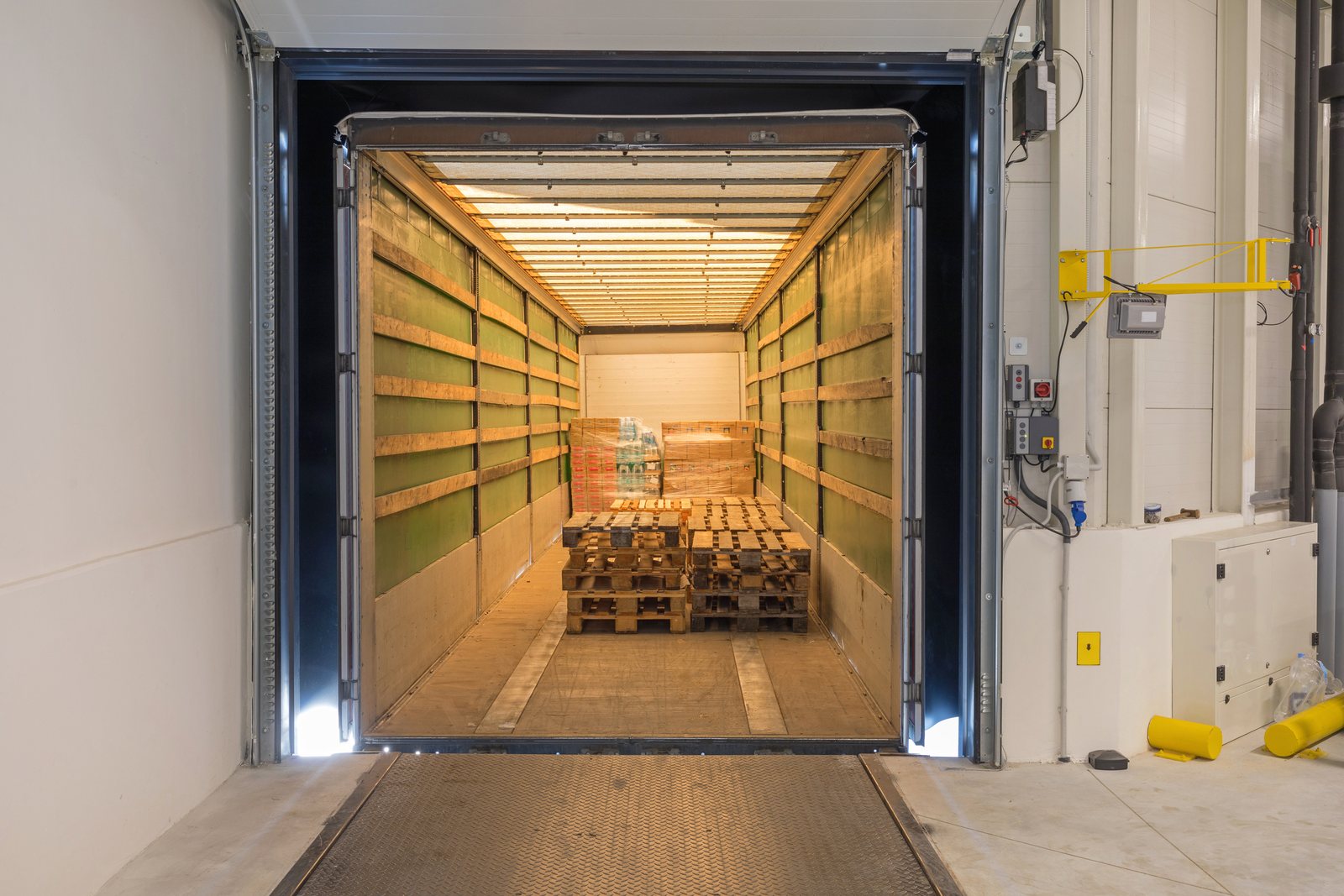
A dry van is an enclosed box trailer. Roof, solid walls, a wood floor, swing doors at the back, and its own wheels and landing gear so it stands up by itself when the tractor pulls away. It holds whatever temperature the day gives it. Every trailer we rent is a dry van, in 28, 45, 48 and 53 foot.
Most of what is written about dry vans is written for people shipping freight on a lane. That is a fair use of the trailer and it is half of what we do. The other half is the trailer sitting still at your building for months, which changes what matters about it. So here is what a dry van actually is, what it is not, what changes when one is parked instead of pulled, and why it is the only trailer type we rent.
- A dry van is an enclosed semi trailer with no climate control. The word dry describes the trailer, not the freight. It does not heat or cool anything.
- It is not a flatbed, a tank or a shipping container. We do not rent or run any of those.
- Our four sizes are 28, 45, 48 and 53 foot. The 28 is the one people forget, and it is the right ask when your lot is tight.
- Parked, the weight limit stops being an axle question and becomes a floor question. Ventilation and loading order become yours to manage.
- Rental runs on a 3 month minimum, then month to month. Call by noon Monday to Friday and same day delivery is the standard across the Tri-State.
What is a dry van trailer?
The parts that matter to a buyer are short to list. The floor sits at dock height, usually around 48 to 52 inches off the ground, so a lift truck drives straight in off your dock and the product never touches the pavement. The inside is just under 100 inches wide, which is why a standard 48 by 40 inch pallet turns two across and not three. Inside height runs about 108 to 110 inches, so there is real stacking room above a pallet.
The floor is the part people underestimate. It is laminated hardwood built to take a loaded lift truck driving on it, not a deck you walk on, and that is the difference between a trailer you can work out of and a box you hand stack from the door. The rest follows from being a sealed box on wheels: it keeps weather and casual theft off your product, it locks, and it has no power, no drains and no climate control.
What is a dry van not?
The words get used loosely and a wrong assumption costs somebody a day. A flatbed is an open deck, for loads too tall or awkward to go through a door. A tank trailer carries liquid or bulk. A refrigerated trailer carries a cooling unit on the nose and holds a set temperature, and we do not rent those or offer cold or heated storage of any kind. If your product needs a temperature held, we will say so on the phone rather than deliver a trailer that cannot do it.
A shipping container causes the most confusion, because it looks similar from fifty feet away. The difference is the running gear. A container is a box with no wheels, set on the ground or a chassis by a crane or tilt bed, and because it sits low you load it from ground level up a ramp. A dry van carries its own axles and sits at dock height, so a lift truck drives in. For a business with a dock, that is most of the decision. Full comparison: storage trailer versus storage container.
Why is a dry van the only trailer we rent?
We have been doing this out of West Chester since 1990, and the calls sort into a short list. A plant has a production run landing before the racking is free. A distributor has seasonal volume that will not fit until February. A contractor needs material on site and locked. A retailer needs back stock off the sales floor. Same problem, different clothes, and a dry van solves all of it.
There is a practical side too. One trailer type means the one we send is the one we quoted, the driver placing it has set a thousand of them, and we are not sourcing equipment elsewhere and marking it up. We own the trucks, the drivers and the trailers. The flip side is that we say no a fair amount, and we would rather lose a call than take a job we cannot do properly.
What sizes do dry vans come in, and which one should you ask for?
Start with the 53, the default and the number every guide quotes. It takes roughly 26 standard pallets on the floor if you fill it like a shipping load. Our pallet math for a 53 foot trailer covers why the storage number is lower than the shipping number.
The 48 foot trailer holds about 24 pallets and is a little easier to place in a yard that was not laid out for long equipment. The 45 is the compromise when a 48 or 53 will not swing into the spot you have in mind but you still need real volume.
Then there is the 28, which the industry calls a pup. It is short enough to tuck into a back lot, a corner by a side door, or a site where a full length trailer cannot turn. People almost never ask for it by name. If you have been told a storage trailer will not work on your property, ask about the 28 before you give up on the idea.
Here is the part the shipping guides leave out, because they are not thinking about a parked trailer. When you are storing rather than hauling, the size question is not how much fits. It is how much you can still reach. A 53 packed solid to the nose is a wall of product you have to unload to get at anything. Two shorter trailers, each loaded with an aisle and a purpose, often beat one long one nobody can work out of. Tell us what you need to pull back out, and when, and that settles the size faster than cubic feet does.
What changes when a dry van is parked instead of pulled?
Take weight first. On the road a 53 foot van is held to roughly 44,000 to 45,000 pounds of payload, and that cap comes from axle and gross vehicle limits, not from the trailer. Parked in your yard, nobody is weighing you at a scale. What still applies is the floor and the concentration of the load, because a tight block of dense product in one section is a different thing from the same tonnage spread across the deck. The real limits are in how much weight you can put in a 53 foot trailer.
Ventilation is the second. A trailer in motion sees constant air exchange and a short trip. A trailer closed up at your fence line for three weeks goes through every temperature swing the Ohio Valley hands it, and an unheated steel and aluminum box sweats when warm damp air meets a cold surface. Cardboard, bare metal, paper labels and anything with a finish all care about that. Winter trailer prep covers what works and what does not.
Access is the third. A shipping load gets loaded once and unloaded once. A storage trailer gets opened over and over by people who did not load it, which means loading in retrieval order, leaving an aisle, and labelling by zone rather than filling from the nose because it is easier on day one. Security follows the same logic: a trailer opened daily sits differently in a yard than one sealed and left. Storage trailer security basics covers placement, locks and seals.
What does a dry van need from your lot?
Room first. A driver needs meaningfully more space than the trailer itself to set it where you want it, and the shape of the approach matters as much as the square footage. A tight corner behind a building with a fence on one side is the one that turns into a problem, and it is better found on the phone than in your lot.
Surface second. Asphalt in July is softer than it looks and the landing gear puts a lot of weight on two small pads, so blocking under the feet solves it. Gravel and compacted stone are usually fine. Soft ground after a wet week is not, and a trailer that settles unevenly gets harder to open.
Dock or ground is the last question. With a dock, the trailer backs in and you work it with a lift truck like any other door. Without one it still sits in the yard and you load it with a dock plate, a ramp or by hand. Our walkthrough of what delivered and spotted actually means covers the day itself. Whether you are in our own back yard in West Chester or at the far edge of the area we serve, the questions on arrival are the same three.
What can you put in a dry van, and what should not go in one?
The rule is simple. If the product would survive an unheated warehouse through an Ohio winter and an Ohio August, it will survive a dry van. If it would not, no trailer we rent changes that, because we have no way to add a temperature. So finished goods, raw material, fixtures, packaging stock, spare parts and archived paperwork all do fine. Anything that freezes, anything that spoils, anything with a humidity spec and anything hazardous we have not talked through first is a no. If you are not sure which side of the line your product sits on, describe it when you call.
How do you get one, and how long do you keep it?
What we need from you is short. The address and the surface. Which size, or a description of the space and the product so we can pick one. Dock or ground level. A rough idea of how long, though that one can move. After the 3 month minimum the rental goes month to month, so a trailer brought in for a seasonal push can stay on for a project or go back when you are done. How long do you actually rent a storage trailer for walks through how that plays out.
Our office is open Monday to Friday, 7:00 am to 6:00 pm. Call (513) 772-9490 or use the quote form and pick Storage Trailer Rental under Interest in. Everything about our commercial storage trailer rental service, all four sizes included, sits on one page if you would rather read first.
The short version
A dry van is an enclosed box trailer with no temperature control, a dock height floor and a deck strong enough to drive a lift truck on. It is the only trailer type we rent, in 28, 45, 48 and 53 foot, because it is the one that answers the space problem almost every caller actually has. Parked, it behaves differently from the trailer the shipping guides describe, and that difference is the whole reason to think about loading order, ventilation and which size you can genuinely work out of. Tell us the product, the space and the dates, and we will tell you which one fits and whether it can be there today.
Frequently asked questions
What does dry van mean in trucking?
Dry describes the trailer, not the freight. A dry van is an enclosed trailer with no refrigeration and no heat, so it holds whatever the outside temperature is. It does not mean your cargo has to be dry, and it does not mean the trailer is sealed against humidity. It simply means there is no climate control of any kind.
Is a dry van the same as a shipping container?
No. A dry van is a highway trailer with its own axles and landing gear, so it sits at dock height and a lift truck drives straight in off your dock. A shipping container has no wheels. It gets set on the ground or on a chassis and is loaded from ground level, usually up a ramp. We rent dry vans only, not containers.
Do you rent refrigerated trailers or offer cold storage?
No. We do not rent reefers and we do not provide cold or heated storage of any kind. Every trailer in our rental fleet is a dry van, which means the inside sits at whatever the outdoor temperature is. If your product needs a temperature held, a dry van is the wrong equipment and we will say so rather than deliver one.
How much can you put in a parked storage trailer?
Parked, the legal axle limits that cap a trailer on the road do not apply, so what matters is the floor rating and how concentrated the load is. Spread the weight across the deck rather than blocking dense product into one section. A 53 foot trailer holds roughly 26 standard pallets on the floor as a shipping load, and fewer in storage once you leave yourself an aisle to work in.
What sizes of dry van trailer can I rent around Cincinnati?
We rent 28, 45, 48 and 53 foot dry vans throughout the Cincinnati Tri-State, inside a 100 mile radius of West Chester that covers southwest Ohio, northern Kentucky and southeast Indiana. The 28 foot is worth asking about if your lot is tight, because it fits places a full length trailer cannot reach. Call by noon Monday to Friday and same day delivery is the standard.